

 OpenAI Quietly Killed ChatGPT's Best Feature OpenAI Quietly Killed ChatGPT's Best Feature
|
|
Google's $100 AI Plan Is Secretly a Storage Deal
|
|
Zapier Costs 40x More Per Task Than Make. Most People Have No Idea.
|
What else happened today?What AI tools should I be using?Good Morning Thorium Valley, welcome back to The Lab.
Today we're looking at whether the most popular chatbot in the world quietly killed the one feature that made everyone sign up in the first place.
We're also breaking down a $100/month AI plan that might actually just be a storage deal in disguise.
And we're finding out if the automation tool everyone uses is really charging 40x more than the alternative, or if that number falls apart when you look closer.
Quickly before we dive in — Be honest — how many AI tool accounts have you created and never gone back to?

GENERAL
Creative writing scores dropped from 97% to 37%. Users are leaving.
ChatGPT Plus costs $20 a month, and millions of people signed up because the writing was good — emails, blog posts, brainstorming, copy. That version of ChatGPT doesn't really exist anymore. When OpenAI launched GPT-5 last August, it optimized for reasoning, coding, and math benchmarks. Creative writing wasn't mentioned once in the launch materials.
Independent testing confirmed what users were already feeling: scores on creative writing tasks collapsed from 97.3% with GPT-4o to 36.8% with GPT-5. On a random Tuesday in February, AI Daily Check collected 49 user reviews — 61% rated it "dumb." OpenAI's own forums are full of Pro subscribers canceling over the downgrade, users who'd built custom writing workflows around GPT-4.5 saying they can't get anything close to the old output, and people questioning why LLM development is chasing math benchmarks instead of the thing most people actually use chatbots for.
OpenAI has shipped several personality patches in nine months — each one an admission users hated how the model sounded. They retired GPT-4o in February 2026 with no warning. A Change.org petition to bring it back got 22,000 signatures. Then they retired GPT-4.5, too. If you loved the old model, there's no going back.
The counterargument is fair: GPT-5 genuinely is smarter at structured tasks. In one marketing email test, it scored 9.5/10 versus GPT-4o's 6.5. But the pattern is too consistent to dismiss. ChatGPT's web traffic share dropped from 87% to about 57% in a year. Claude grew from 1.4% to 6%.
One quote stuck with me. A user on the OpenAI forum shared that they have depression and GPT-4o helped them write when they couldn't do it alone. GPT-5 took that away. That's not a benchmark. That's someone's life.

If you use ChatGPT mainly for coding, data analysis, or structured reasoning, GPT-5 is genuinely better and the $20 is well spent. If you use it for writing, creative work, brainstorming, or anything that requires tone and nuance, Claude is the better tool right now and it's the same price. OpenAI chose to trade writing quality for benchmark scores, and they didn't tell you. Now you know.

GENERAL
20TB of storage, YouTube Premium, and frontier AI for the price you'd pay for storage alone.
Google restructured its entire AI pricing at I/O 2026, and the $100 AI Ultra tier is the most interesting thing any AI company has done with pricing all year. Not because the AI is the best available — because the math is almost suspicious.
Here's what the new tiers look like:
- $100/month Ultra: 20TB of Google cloud storage (roughly $100 on its own), YouTube Premium ($13.99/month value), and 5x the usage limits of the $20 Pro plan
- $200/month Ultra (down from $250): Bumps limits to 20x Pro and adds Project Genie, Google's experimental world-building tool
If you already pay for YouTube Premium and any meaningful amount of Google storage, the AI features are essentially free.
The AI itself is solid but not leading. Gemini 3.5 Flash, the new default model, is now available to everyone including free users — so what you're paying for with Ultra isn't a better model, it's higher limits and priority access. Google switched to compute-based metering, meaning your allowance depends on how complex your prompts are and refreshes every five hours until you hit a weekly cap.
In practice, those limits can bite. One user posted video proof that a single failed video-generation prompt burned through their entire five-hour allowance in minutes. Google has since tripled the limits for their Antigravity coding tool twice already — a clear sign the original caps were too tight.
Both Ultra tiers also get Gemini Spark, a new always-on AI agent that can navigate across Google's products to handle tasks for you. It's US-only, still in beta, and Google's own language encourages you to supervise it closely. The more powerful 3.5 Pro model, meanwhile, drew a groan from the I/O audience when Pichai announced it wouldn't arrive until June. And for competitive context, this puts Google at the same $100/$200 split as OpenAI's Pro tier, while Meta just entered the ring with plans starting at $7.99.
If you already spend $50 or more a month on YouTube Premium and Google storage, the $100 Ultra plan is a genuinely good deal because you're recouping most of the cost through services you'd buy anyway. If you don't live in Google's ecosystem, the AI alone doesn't justify switching from Claude or ChatGPT. Claude is still the stronger tool for writing and reasoning, and ChatGPT has better memory and third-party integrations. Google made the subscription math irresistible for its own users. For everyone else, the AI needs to catch up to the price tag.
PRODUCTIVITY
The cost comparison is real. The switch is harder than Reddit makes it sound.
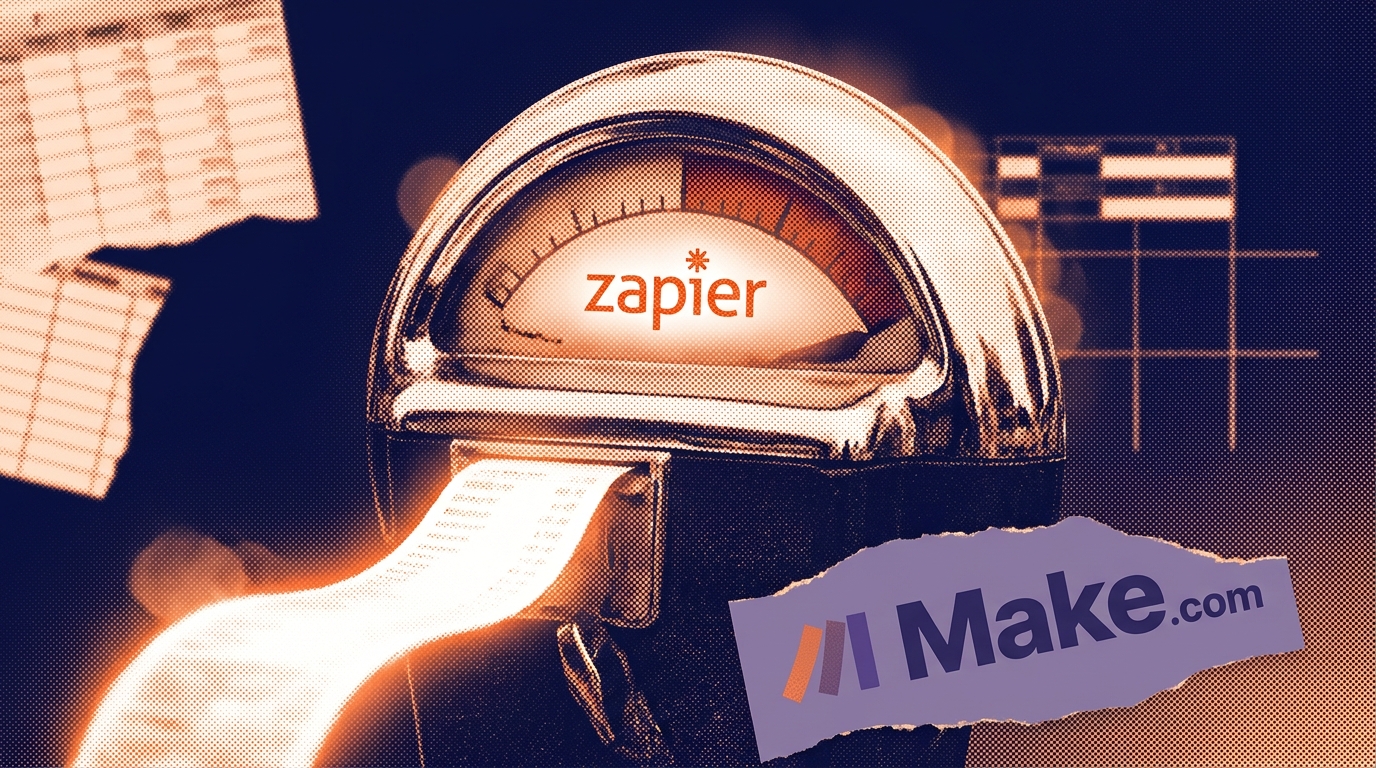
Zapier's Starter plan runs $29.99 a month for 750 tasks. Make's Core plan runs $9/month billed annually for 10,000 operations. Do the math on cost per unit and Zapier is roughly 40 times more expensive, and at higher volumes the gap can be even wider.
Those numbers have been circulating on Reddit and YouTube for months, and they're directionally true. One automation consultant said he recommended Zapier to clients for over a decade but stopped "when the cost gap became indefensible." A Reddit user in r/automation put it more bluntly: "The better your systems work, the more you pay. You're essentially renting leverage instead of owning it."
The comparison isn't as clean as it looks though. Zapier counts only successful action steps as tasks. Triggers and failed steps are free, but filters and other logic steps do consume tasks when they run successfully. Make counts every module execution including triggers, routers, and conditional logic. A five-step Zapier workflow where one step is the trigger uses four tasks. That same workflow on Make could burn through dozens of operations depending on how it's built. One hands-on comparison found that Make could actually cost more than Zapier in practice because Make's polling triggers kept checking for data that didn't exist, burning through operations on empty cycles.
So the 40x number is real at the unit level and completely misleading in certain real-world scenarios. Zapier's own pricing analysis of Make points out that Make's support team suggests about 19 hours of training before building production workflows. That's not nothing.
Then there's n8n, which just doubled its valuation to $5.2 billion after SAP made a strategic investment and announced plans to embed it into SAP Joule Studio. One user who migrated to self-hosted n8n on a $6/month server reported saving $320 to $500 a year. But n8n has a few hundred native integrations compared to Zapier's 7,000+. If you rely on niche tools, Zapier is often the most likely platform to connect without custom work.
The real problem isn't the per-task price. It's that most people picked Zapier when they had five automations and now they have fifty, and switching is harder than anyone expects. Zapier's own vendor lock-in survey found that 89% of leaders think they could switch platforms within a month. But 58% of those who actually tried said it either failed or took way more effort than planned.
If you're running simple automations across a lot of different apps and your team isn't technical, Zapier is still the easiest option and the premium is the price of convenience. If you're running complex, high-volume workflows and your team can handle a learning curve, Make can save you real money. If you have someone technical enough to manage a self-hosted setup, n8n can be the cheapest by far, and SAP just validated it as enterprise-ready. The 40x headline is true on a spreadsheet. Whether it's true for your setup depends entirely on what you're automating and how many operations your workflows actually consume.

EVERYTHING ELSE IN AI
+ Pope Leo XIV calls for AI to be "disarmed" in his first encyclical, declaring it "not permissible" to let AI make lethal decisions
+ Musk and Zuckerberg personally called Trump to kill the AI safety executive order the night before he was set to sign it
+ Andrej Karpathy left OpenAI for Anthropic to build a team that uses Claude to train the next version of Claude
+ Taiwan charges three people with smuggling Nvidia chips to China through Japan in fake export documents — including a Super Micro board member
+ Qualcomm strikes a deal with ByteDance to supply millions of custom AI chips designed to sidestep U.S. export controls
+ Nvidia's China chip sales went from $4.6 billion to literally zero in a single quarter
+ xAI tells staff to stop talking to Cursor employees over antitrust concerns — weeks after they were already working together in the same offices
+ Only 18% of Gen Z feels hopeful about AI graduation crowds are booing any speaker who mentions it

OTHER TOOLS
+ Wispr Flow (sponsored): The new viral voice-to-text AI for iPhone and Mac that actually understands what you're saying every time
+ Superpower (sponsored): The health app that tests your blood and uses AI to tell you what's actually going on with your body before your doctor does
+ Claude Code: The latest update lets you run `/code-review --fix` to automatically find and apply code improvements — catching redundancies, simplifications, and efficiency gains without leaving your terminal
+ MAI-Image-2.5: Microsoft's new image generator just debuted at No. 3 on the Arena leaderboard, with notably sharper text rendering on posters, labels, and packaging — the stuff that usually trips AI image tools up
+ Base MCP: Coinbase's new plugin lets you swap tokens, track your portfolio, and use DeFi apps like Uniswap and Morpho directly from a chat with Claude or other AI assistants — no switching between apps
+ Google Search: Google is replacing its classic search bar with an expandable, AI-powered box that accepts files, photos, videos, and even open Chrome tabs as input — powered by the new Gemini 3.5 Flash model
+ Novee Agentic Fix: This security startup finds vulnerabilities in your app, then automatically sends the fix straight to your coding assistant — Claude, Copilot, or Cursor — so it can open a pull request for you
That's the Lab for this week. If a tool in here saved you time or wasted it, tell us — reply directly. Written by Jason Chen, Advait Prakash, Andrew Hales, and the Thorium Valley crew. Got a tool you want us to review? Reply with the name and we'll put it on the list.
Written by Jason Chen, Advait Prakash, Andrew Hales, and the Thorium Valley crew.
That's all for today's Lab. See you next time.